The attention economy: why your event wins attention through people
An event needs attention long before the first person walks into the room, and attention is exactly what's scarce on LinkedIn. In the feed, your event competes with everything else your audience sees that day: news, job ads, travel photos, a former colleague's promotion. Here you'll find out what's behind the term attention economy and where OneClickBadge comes in.

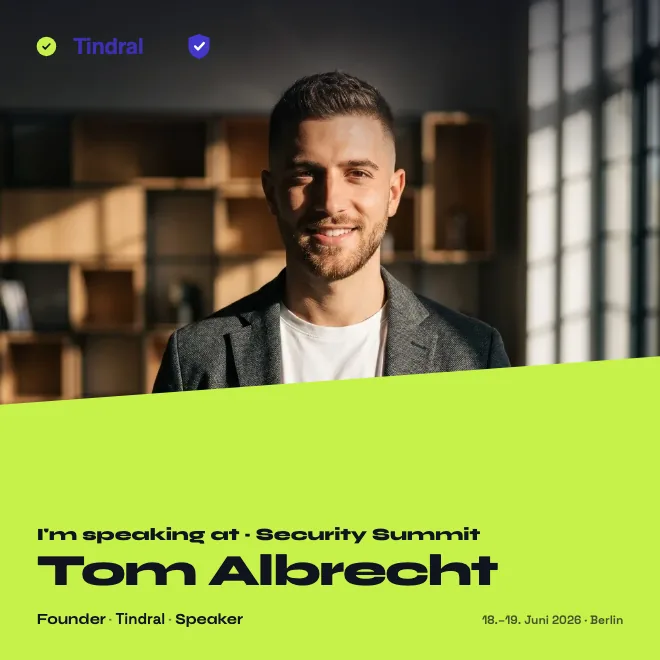
In June I'm speaking at the Security Summit in Berlin about secure supply chains. If you're going to be there, come and say hello!
What the attention economy means
The attention economy describes a simple shift: once information is abundant, people's attention becomes the scarce resource. Everyone who has something to say then competes for it, from the online shop to the specialist conference.
Herbert A. Simon, who later won the Nobel Memorial Prize in Economics, described the core of it in his essay “Designing Organizations for an Information-Rich World”, published in 1971: a wealth of information creates a poverty of attention, because information consumes the attention of its recipients. Michael Goldhaber in the US applied the idea to the internet in 1997. In German-speaking countries, Georg Franck made it widely known with his 1998 book “Ökonomie der Aufmerksamkeit” (The Economy of Attention).
Your event competes with the entire feed
For organizers, the theory gets very practical as soon as you look at the feed of a typical person in your audience. Between two posts from contacts there's an ad, then the page of a software vendor, a job posting, a long piece on leadership. Your post about the June conference turns up somewhere in that line. A thumb scrolls past it, and nobody has consciously decided against you.
LinkedIn sorts this feed individually for each person. In its engineering blog, the network described in 2020 how it measures how long a post stays visible in the feed, counted from the moment at least half of it is on screen. According to LinkedIn, it uses this dwell time to improve the order of the feed. LinkedIn doesn't disclose how much weight the signal carries today. Still, it seems likely that a post almost everyone scrolls past tends to slide further down the feed.
The myth of the goldfish attention span
Read about attention for long enough and you'll come across the claim that people can now concentrate for only eight seconds, less than a goldfish. The figure became famous in 2015 through a report by Microsoft Canada. Microsoft hadn't collected it: the report took it from a statistics website, and those who traced the number back, LinkedIn's marketing blog among them in 2016, found no study behind it.
Writing in a scientific journal in 2016, the physiologist Neil Bradbury added that nobody knows how you would even measure a goldfish's attention span. According to Bradbury, the eight seconds come closer to describing how long someone stays on a web page on average before looking elsewhere. That has little to do with the ability to get absorbed in a talk or a long article. In the feed, the decision about what deserves your time is simply made very quickly.
What makes people stop in the feed
Nobody outside LinkedIn knows exactly how the feed is sorted in detail. A few patterns are well founded, though, most of them by studies, and they fit nicely with what an event needs.
Senders you know. Recommendations from the people around us enjoy more trust than anything a brand says about itself. In Nielsen's 2015 global survey “Global Trust in Advertising”, 83 percent said they completely or somewhat trust recommendations from friends and family. Brand websites came to 70 percent. A contact on LinkedIn isn't automatically a friend. It stands to reason, though, that a message carries more weight when you know the person behind it.
Faces. In 2014, researchers from the Georgia Institute of Technology and Yahoo Labs analyzed around 1.1 million photos on Instagram. Photos with faces were 38 percent more likely to get likes and 32 percent more likely to get comments. How many faces were visible and how old the people were made no difference. The study left open why this is so, and Instagram isn't LinkedIn.
Lots of people from your own circle. A single post about an event is a piece of news. If someone sees the same design from three different contacts over two weeks, the impression changes: a lot of people I know are going there. The psychologist Robert Cialdini calls this social proof. People are more inclined to think something is right when many in their own group are doing it.
Motion. According to LinkedIn Help, videos can play automatically and without sound as you scroll. In experiments by Richard Abrams and Shawn Christ from 2003, participants identified a target letter faster when it had just started to move. Letters that were already moving had no such advantage. A video that starts playing as someone scrolls delivers exactly that moment of onset.
Why your own channel reaches its limits
Your own page still matters. That's where the program and tickets are, and the people who follow you want to hear about them. In the competition for attention, though, it has two drawbacks. It mostly reaches people who already know you. And every one of its posts is recognizably self-promotion. Ads extend the reach for money, but they remain labeled as paid posts.
A speaker's post has neither drawback. It runs in that person's network, which only partly overlaps with your followers, and it sounds like a personal message: I'm speaking there, come along. How much reach many posts like this add up to is worked out in the article on the network effect, using an example with openly stated assumptions.
Mostly reaches your followers and is read as a message from the organizer.
Runs in that person's network, with a face, a name and their own words.
Your speakers have little attention to spare, too
Simon's idea has a second side that event marketing often overlooks. Every message draws on the attention of whoever receives it, and that includes your request to post. In the weeks before the event, speakers get emails about tech, travel, slides and the schedule. One more email asking for a post about the event is, above all, work for them.
How much work is up to you. With a logo pack and color codes, every speaker would have to build the graphic themselves, and between two meetings there's rarely time for that. Behind a link with a finished design, only the photo and name are missing, which takes a few minutes. Where attention is scarce, the request that costs the least of it stands the best chance. Email building blocks and the right timing are in the guide Get speakers to post.
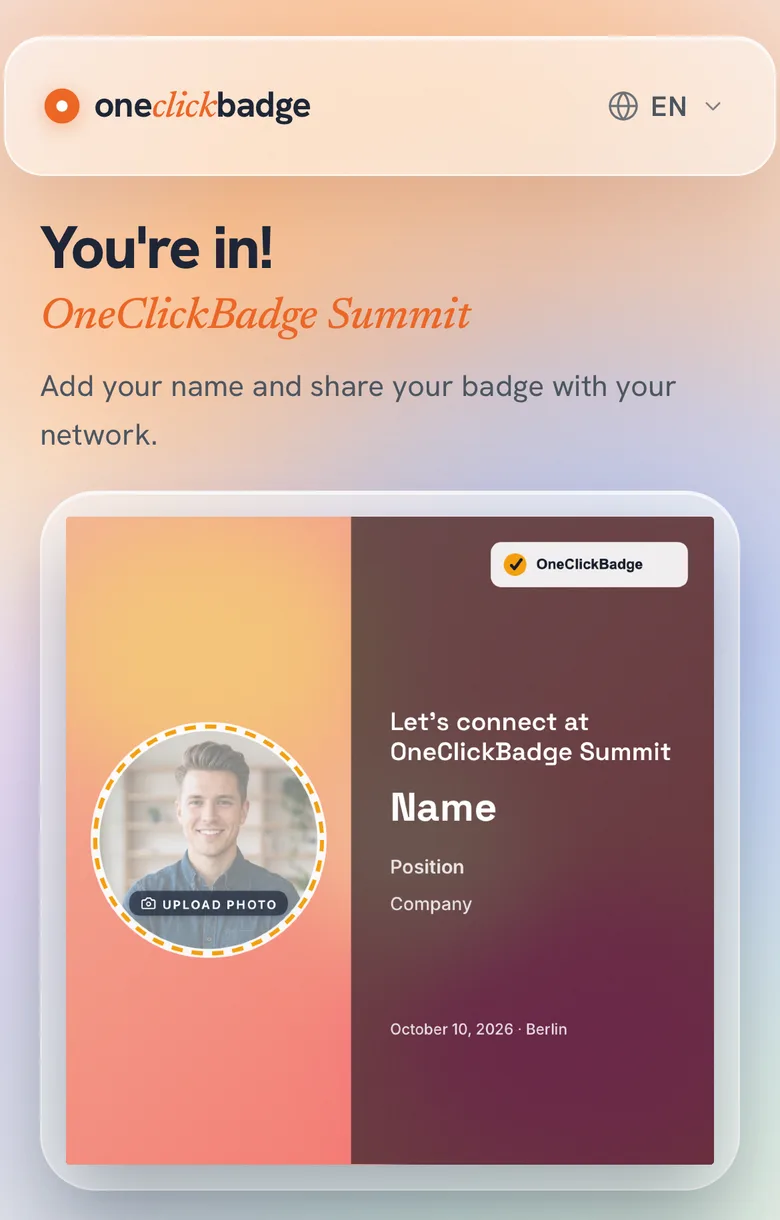
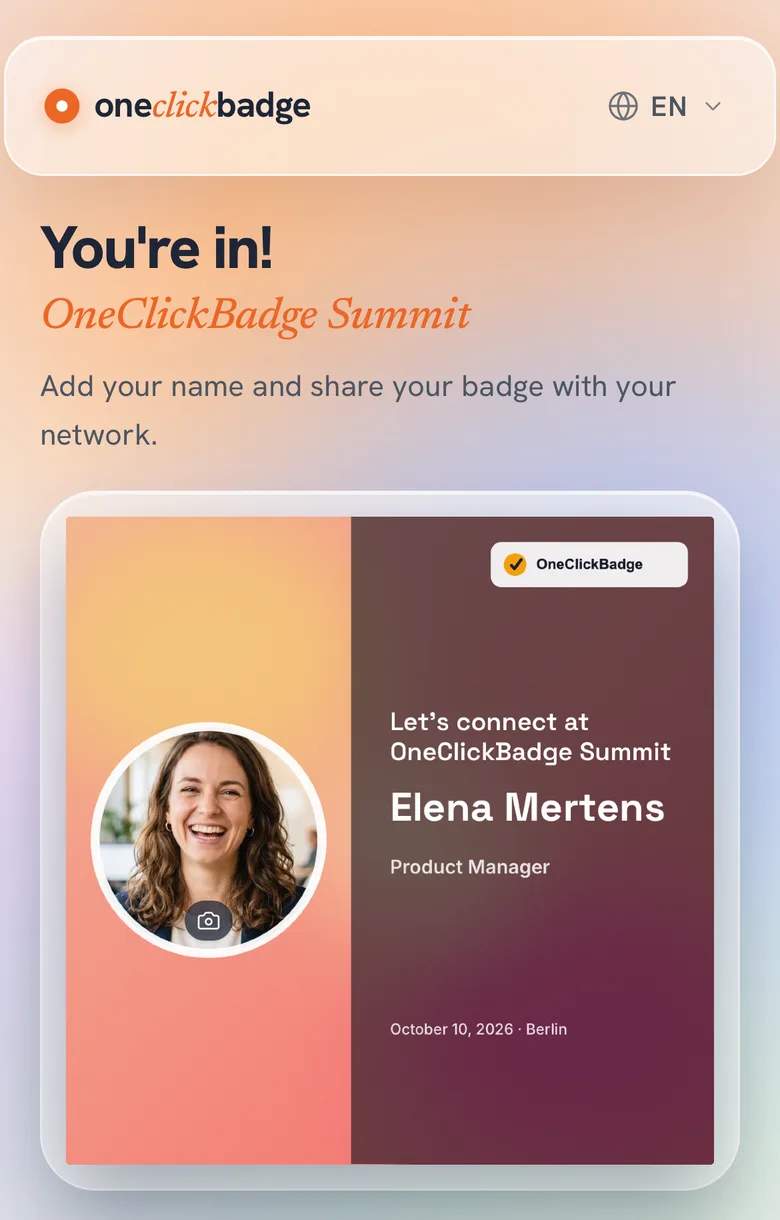
The two screenshots below show this path on the OneClickBadge demo page, on a phone, just as your guests see it.
How OneClickBadge uses these patterns
Every speaker brings a face, a familiar name and a network of their own. What's usually missing is a finished design that can be posted in a few minutes and looks like your event no matter who posts it. OneClickBadge provides exactly that. You design a badge once with your logo, colors, event name and date, and send your speakers, exhibitors and guests the matching link. There, each person adds their photo and name. Your guests don't need an account for this.
The table shows where each pattern from above shows up in the product. Motion is optional: tick a box in the editor and you also offer an animated badge.
| Pattern | Where it is in OneClickBadge |
|---|---|
| Little effort | Guests only need a photo and name. On a computer, one click copies the finished image. On a phone, one button shares image and text. You suggest the post text. |
| Senders you know | The post goes out from the person's own profile into their network, without an ad label. |
| Faces | The person's own photo has a fixed place in the badge. It stays in the browser, background removal included. |
| Lots of people from your own circle | All badges come from the same design. Anyone who sees it from several contacts recognizes your event. |
| Motion | If you want it, a short silent video, created in your guests' browser as MP4 or WebM. |
Attention before, during and after the event
An event gives people things to talk about over several weeks. Each of these occasions is a new chance to show up in the feed, and each has a matching building block.
- With the confirmation: speakers get their link together with the confirmation, while the excitement is still fresh. For exhibitors, the “We're attending” template is a good fit.
- In the weeks before: once the program is set, there's a new occasion. A short reminder to those who haven't posted yet now has some news to share. The posting rhythm for your event page is in the guide Promote your event on LinkedIn.
- On the day: share the link with your guests on site using the QR card from your dashboard. Someone sitting in the audience has a good reason to post. The guide Post live from your event collects ideas for that.
- After the event: your guests add an attendance certificate to their profile. LinkedIn opens a pre-filled form for it that they only need to check and save. A post in the feed drops out of sight after a few days. The entry under Licenses & certifications stays, and anyone who looks at the profile later finds your event there.
What a badge can't do
A badge makes it visible that people are coming to your event and carries that message into their networks. If the program doesn't interest anyone, even the most beautiful design won't change much.
Nobody can promise you in advance how many of your guests will post or how far their posts will travel, and that includes us. LinkedIn doesn't disclose its ranking in detail, and every network is different. Our expectation is that more people join in when posting takes less effort and the image feels more personal.
How to put it into practice at your next event
- Pick one of the templates and add your logo, colors, event name and date. Decide what your guests may fill in themselves.
- Write a suggested post text and encourage your guests to put it in their own words. Posts written in a personal voice read like recommendations from people you know.
- Send your speakers their link with the confirmation, and your guests theirs with the registration confirmation.
- With an account, adapt the page behind the link with your own welcome message and colors. The guide Customize your event shows how.
- Plan the attendance certificate in from the start, so your event stays in the conversation after the last talk.
Related
This is what the link your guests receive looks like. Try it with your own photo. Nothing gets saved.
Frequently asked questions
- What does attention economy mean in simple terms?
- When there is more information than people can take in, their attention becomes the scarce resource. Anyone who wants to be seen or heard then has to compete for it.
- Who coined the term attention economy?
- The basic idea comes from Herbert A. Simon, who wrote in an essay published in 1971 that information uses up the attention of the people who receive it. Michael Goldhaber popularized the attention economy as a term for the internet in 1997. In 2001 the business book “The Attention Economy” by Thomas Davenport and John Beck followed. In German-speaking countries, the topic is associated with Georg Franck and his book “Ökonomie der Aufmerksamkeit”.
- What are examples of the attention economy?
- The best-known example is platforms that make their money by selling their users' attention to advertisers. In a 2017 interview with the German marketing magazine Horizont, Georg Franck named Google and Facebook as companies that are “successful to an already worrying degree” with this business model. In everyday life it shows up in the sorted feed and in videos that start playing on their own as you scroll. For organizers, this means every announcement competes with everything else in the feed.
- What are the criticisms of the attention economy?
- Georg Franck himself is one of its critics. In the same interview he said: “Reducing attention to a currency creates a kind of blindness of the soul.” For organizers, that's a useful warning. Volume alone is a poor goal, which is why the patterns in this guide rely on trust and on people who choose to talk about your event.
- Is this worth it for small events too?
- Yes. The mechanism depends on people and hardly at all on budget. Even a meetup with a few dozen guests has speakers and regulars whose networks reach far beyond your own mailing list. In specialist circles, a single personal post often reaches exactly the people you want to reach.
- Doesn't a badge look like advertising?
- Usually less than a post from your event page, because a person with their own photo and name stands behind it and decides whether to post and what to say. To keep it that way, include a suggested text and leave the wording up to them. When someone adds two sentences of their own about their topic, the post reads like a message between colleagues.
- Do your guests need an account or an app?
- No. Everything happens in the browser: your guests open the link, add a photo, enter their name and save the finished image. The photo isn't uploaded along the way. There's more on this in Badges and data privacy.
- Where do the numbers in this article come from?
- The percentages come from Nielsen's survey on trust in advertising (2015) and the Georgia Institute of Technology study on faces in photos (2014). Neither comes from LinkedIn or the events industry, and neither predicts anything for your event. What LinkedIn says about dwell time and autoplay is in its engineering blog and its help pages. The sources for these numbers are linked at the end of the page.
Sources
- Michael H. Goldhaber: The attention economy and the Net. First Monday 2 (4), April 1997
- Georg Franck: Warum der Begründer der „Ökonomie der Aufmerksamkeit“ immer noch goldrichtig liegt (Horizont, interview in German, October 2017)
- Nielsen: Global Trust in Advertising, September 2015
- Face It: Instagram Pictures With Faces are More Popular (Georgia Tech, March 2014)
- LinkedIn Engineering: Understanding dwell time to improve LinkedIn feed ranking (May 2020)
- LinkedIn Help: Manage video autoplay settings
- Jason Miller (LinkedIn Marketing Blog): The great goldfish attention span myth (November 2016)
- Neil A. Bradbury: Attention span during lectures: 8 seconds, 10 minutes, or more? Advances in Physiology Education 40 (4), 2016, pages 509 to 513
- Richard A. Abrams, Shawn E. Christ: Motion onset captures attention. Psychological Science 14 (5), 2003
Details about external platforms last checked on October 10, 2026.